A cleanroom may take months to design, manufacture and qualify, but it is expected to perform reliably for many years.
During the design phase, attention naturally focuses on immediate requirements: cleanroom classification, airflow, pressure differentials, temperature and humidity, process flows, equipment integration and regulatory compliance.
But there is another question that should be considered just as early:
How will this cleanroom actually be maintained five, ten or even twenty years from now?
HEPA filters will eventually need attention or replacement. HVAC components will require servicing. Sensors will need calibration. Lights, doors and electrical components may fail. Production equipment will be upgraded or replaced. Utilities may need modification as processes evolve.
How easily these activities can be performed — and how much they interfere with production — depends to a large extent on decisions made before the cleanroom is ever built.
This is why maintainability should not be treated as an operational issue to be solved after commissioning. It should be an integral part of cleanroom design.
A cleanroom is not a static environment
Once a cleanroom has been qualified and production begins, it can appear to be a finished facility. In reality, it is a complex technical environment that requires continuous monitoring, servicing and periodic intervention throughout its operational life.
HVAC systems, filtration, pressure-control systems, monitoring equipment, doors, lighting, utilities and other components all have different inspection and maintenance requirements.
This is particularly important in GMP environments.
Maintenance cannot simply be approached in the same way as it would be in a conventional commercial or industrial building. An intervention may affect the state of the controlled environment and needs to be considered in relation to contamination risk, product quality and the qualified state of the facility.
Guidance for pharmaceutical HVAC systems reflects this lifecycle approach: planned preventive maintenance is expected, maintenance activities should not negatively affect product quality, and interventions may require an assessment of whether qualification or requalification is necessary.
The question, therefore, isn’t whether maintenance will be required.
It is whether the facility has been designed to make that maintenance controlled, efficient and minimally disruptive.
Where will you replace the HEPA filters?
HEPA filtration is a good example of why maintenance needs to be considered during design.
When designing the ceiling and ventilation system, engineers naturally consider filter quantity, location, airflow distribution, pressure drop and required cleanliness levels.
But another practical question matters:
How will each filter be accessed when it needs to be tested, serviced or replaced?
If the only practical access is through the cleanroom itself, maintenance may require personnel and tools to enter a controlled space. Depending on the area and activity involved, this can create additional contamination-control considerations, cleaning requirements and potentially an impact on operations.
The consequences of replacing the filter also matter. Pharmaceutical HVAC guidance, for example, specifies that HEPA filter replacement should be followed by installed filter leakage testing.
Where technically feasible, providing suitable access from technical or service areas can make future interventions considerably easier.
This principle extends well beyond HEPA filters.
Can technicians reach what they need to maintain?
A technically sophisticated system is not necessarily a maintainable one.
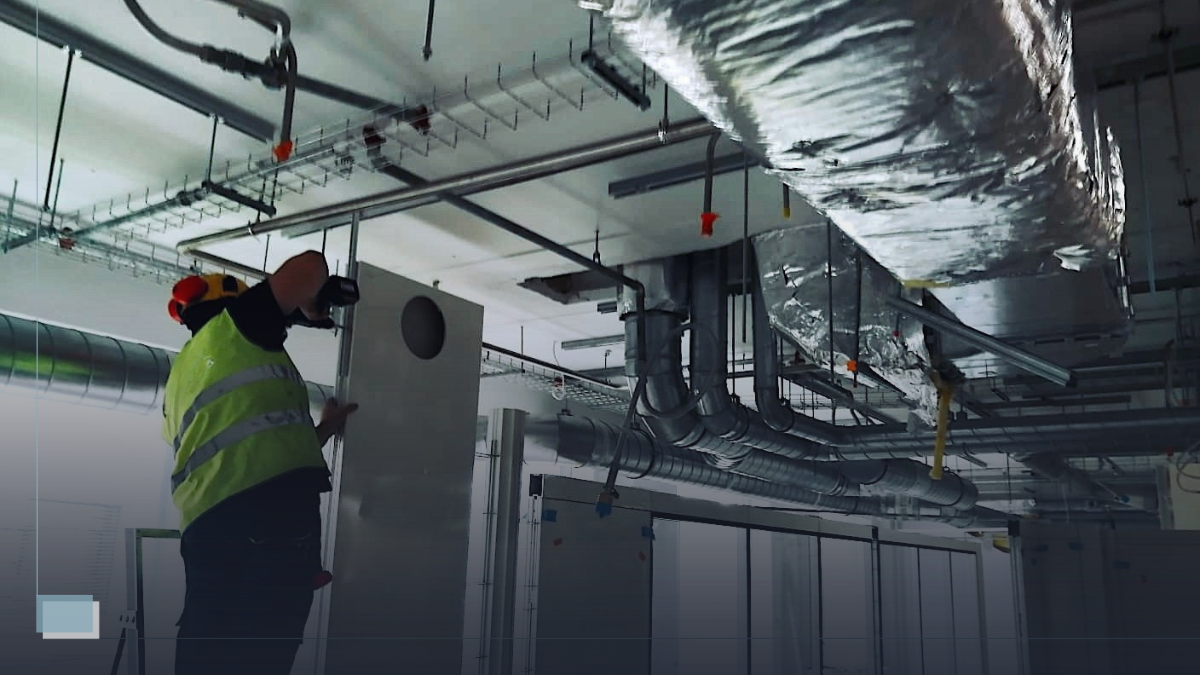
Dampers, valves, sensors, actuators, electrical connections, ductwork, piping and other services may all work perfectly when the cleanroom is commissioned. Years later, however, someone needs to inspect, calibrate, repair or replace them.
A component positioned in an inaccessible ceiling void can turn what should be a routine maintenance task into a significant intervention.
Good cleanroom engineering therefore considers not only where components fit, but also how people will reach them.
Questions during design should include:
- Can critical HVAC components be accessed safely?
- Is there sufficient working space around equipment?
- Can filters and other consumables be removed and replaced without dismantling surrounding systems?
- Are valves, sensors and control components positioned where technicians can reach them?
- Can utilities be isolated locally when maintenance is required?
- Can maintenance be carried out from a technical area rather than from inside the cleanroom wherever possible?
These may seem like relatively small details on a drawing.
Over the lifetime of a facility, they can make a significant difference.
What happens when something inside the cleanroom fails?
Not every component can be located outside the controlled environment.
Doors, lights, wall and ceiling elements, pass-through systems, electrical outlets and various process utilities form part of the cleanroom itself.
Eventually, some of them will require intervention.
The design should therefore consider not only durability, but replaceability.
For example, if a ceiling-mounted component fails, can it be replaced without dismantling a large section of the ceiling? If a wall panel becomes damaged, can the affected element be changed individually? If a door component needs servicing, how easily can technicians access it?
Modular cleanroom construction can offer an advantage here when the system has been engineered with individual, accessible and replaceable components in mind.
The objective isn’t to assume that nothing will ever fail.
It is to make sure that when something does, the facility can recover from it efficiently.
Maintenance can become a production issue
In pharmaceutical and biotech manufacturing, the cost of maintenance is not limited to the technician’s time or the price of a replacement component.
The larger cost can be the impact on operations.
Imagine that a relatively simple HVAC intervention requires access through an active production area. Production may need to stop. The area may then require cleaning and environmental checks before operations can resume. Depending on the nature and extent of the intervention and the facility’s procedures, additional testing or requalification may also need to be considered.
A relatively inexpensive maintenance task can therefore have consequences far beyond the cost of the component being replaced.
This changes the way lifecycle costs should be evaluated.
When comparing two design solutions, the lowest initial investment is not necessarily the least expensive solution over the life of the facility.
Providing better technical access, appropriate isolation points or a more serviceable system during construction may require additional consideration at the beginning of a project.
But if that decision reduces repeated production interruptions over the next decade, its value can be considerably greater than its initial cost.
Don’t forget the production equipment
Maintainability is not limited to the cleanroom infrastructure.
Production equipment itself changes.
A filling line may be replaced. A new process skid may be introduced. Laboratory equipment may become larger or more automated. Production capacity may increase.
This raises another deceptively simple design question:
How will the equipment get out?
Equipment that fits easily through a facility during initial construction may become surprisingly difficult to remove once walls, doors, airlocks and surrounding production areas are operational.
Equipment replacement routes should therefore be considered during facility planning.
Door dimensions, corridors, removable wall sections, ceiling heights, turning radii and access from external areas can all become important years after the initial project has been completed.
Designing for these scenarios does not mean predicting exactly what equipment will be installed in 15 years.
It means avoiding design decisions that unnecessarily restrict future options.
Maintenance should be considered alongside contamination control
There is also a broader GMP perspective.
Modern contamination-control thinking encourages manufacturers to consider the facility, equipment, processes, personnel, utilities and procedures as interconnected elements rather than isolated systems.
Maintenance belongs within that same thinking.
If routine technical work repeatedly requires opening controlled areas, crossing personnel and material flows or accessing critical spaces, the maintenance strategy itself can become a source of contamination risk.
Good facility design can help separate these activities.
Technical corridors, accessible ceiling voids, appropriately positioned service panels and well-planned utility distribution can allow many interventions to take place without unnecessarily disturbing the controlled environment.
The aim is simple:
When maintenance becomes necessary, it should disturb the cleanroom as little as reasonably possible.
Documentation matters too
Physical accessibility is only one aspect of maintainability.
A facility must also remain understandable years after commissioning.
Accurate as-built drawings, HVAC schematics, equipment information, maintenance instructions, control-system documentation and spare-parts information become increasingly valuable as personnel change and the facility evolves.
Good documentation also makes future modifications easier to assess.
When a production line changes or a cleanroom is expanded, engineers need to understand what was originally installed, why it was designed that way and how the proposed modification could affect the rest of the system.
Lifecycle planning therefore starts with physical design but continues through documentation, preventive maintenance and change management.
Modular cleanrooms and lifecycle thinking
Modularity is often associated with shorter installation times and greater flexibility. But one of its less-discussed advantages is the opportunity to consider the facility as a system of components that can be accessed, replaced, modified and expanded.
That does not happen automatically simply because a cleanroom is modular.
Maintainability still has to be engineered into the solution.
Panel systems, ceilings, technical spaces, HVAC distribution, utilities and equipment interfaces should all be designed with future interventions in mind.
For facilities where production requirements may evolve significantly over time, this approach can also support future modifications without requiring the entire controlled environment to be rebuilt.
The real value of modularity, therefore, is not simply how quickly a cleanroom can be assembled.
It is also how intelligently the facility can respond to what happens after commissioning.
Designing beyond Day 1
Cleanroom projects understandably place enormous emphasis on reaching commissioning and qualification.
But qualification is the beginning of the operational lifecycle, not the end of the project story.
A facility that performs perfectly on Day 1 but is difficult to maintain, modify or service can create unnecessary challenges for years afterwards.
The better approach is to ask lifecycle questions while changes are still relatively easy to make:
Where will the HEPA filters be replaced?
How will technicians reach the HVAC components?
Which services can be accessed without entering classified areas?
What happens if a ceiling panel, light or utility connection needs replacing?
Can production continue while maintenance takes place elsewhere?
And how will major equipment eventually be removed?
At NAYA Life Sciences, we believe cleanroom engineering should consider not only how a facility will be built and qualified, but also how it will be operated, maintained and adapted throughout its working life.
Because a successful cleanroom isn’t simply one that performs as required when it is handed over.
It is one that continues to perform — and can be efficiently maintained — for many years to come.