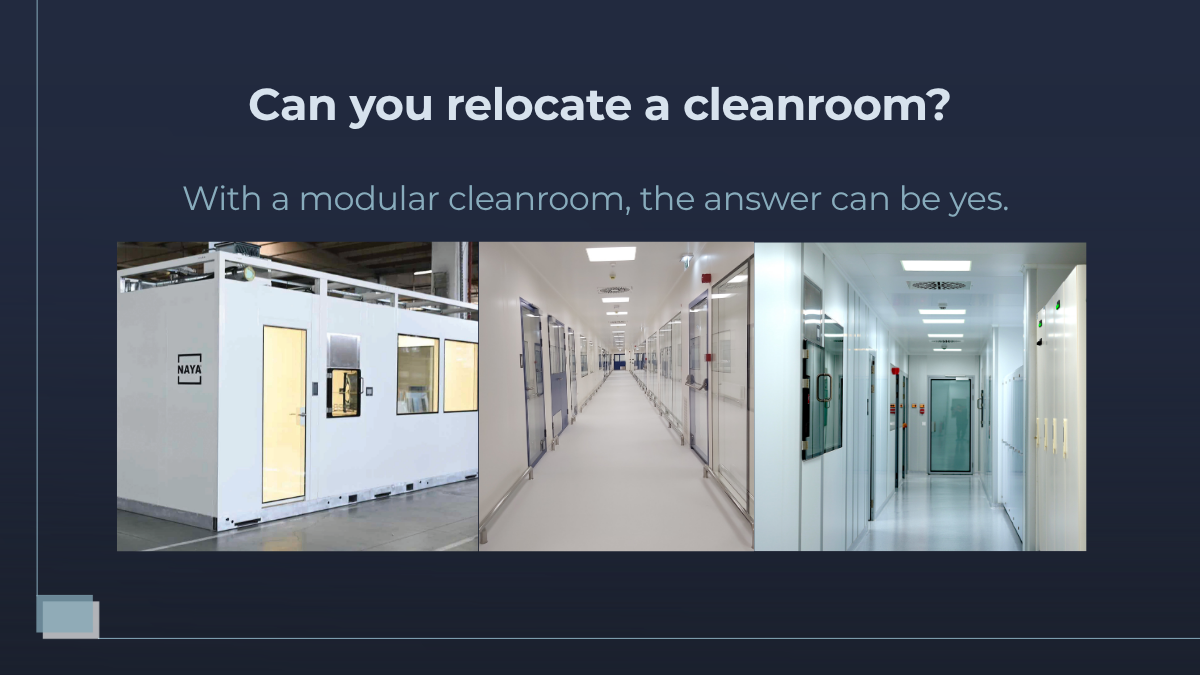
When production needs change, does your cleanroom have to stay where it was originally built?
With a modular cleanroom, the answer can be yes – relocation may be possible.
Unlike conventional cleanroom construction, modular cleanrooms are built from prefabricated components designed to form an integrated controlled environment. Depending on the system, its condition and the requirements of the new facility, selected components can potentially be dismantled, reused and reconfigured.
This can provide manufacturers with greater flexibility when production expands, processes change or operations move to another location.
What parts of a modular cleanroom can be reused?
Relocating a modular cleanroom does not necessarily mean moving the entire facility exactly as it is.
Depending on the original design and condition of the system, components that may potentially be dismantled and reused include:
- wall panels,
- ceiling panels,
- doors and door systems,
- glazing,
- profiles and structural elements,
- selected integrated components.
Before reuse, each component should be assessed to determine whether it remains suitable for the intended application and the requirements of the new cleanroom.
Relocation is more than dismantling and rebuilding
A modular cleanroom should not simply be taken apart in one building and reconstructed identically in another.
The new facility may have different dimensions, infrastructure and production requirements. The cleanroom therefore needs to be considered within its new environment and intended process.
Several aspects may need to be redesigned or adapted, including:
Layout and process flow
The room configuration may need to change according to available space, equipment placement and personnel and material flows.
Airflow and HVAC
The new facility may require different airflow patterns, air-change rates, filtration or HVAC capacity to achieve the required environmental conditions and cleanroom classification.
Utilities and technical integrations
Electrical systems, process gases, compressed air, water, data connections and other services need to be coordinated with the infrastructure available at the new location.
Cleanroom classification and requirements
A change in production process or intended use may result in different cleanliness, pressure, temperature, humidity or regulatory requirements.
Qualification and validation
Once reconstructed and commissioned, the cleanroom needs to demonstrate that it meets the applicable requirements for its new configuration and intended use.
Designing today with tomorrow in mind
The possibility of relocation highlights one of the broader advantages of modular cleanroom construction: adaptability.
A cleanroom may be designed for today’s production requirements, but manufacturing environments rarely remain unchanged indefinitely. Companies expand, equipment is replaced, processes evolve and production lines may move.
Considering these possibilities during the initial design phase can make future changes easier to accommodate.
Modularity can allow a cleanroom to be expanded, reconfigured or, where technically appropriate, partially relocated, potentially allowing suitable components to remain in use instead of starting completely from scratch.
Modular means flexibility
Speed of installation is often one of the first advantages associated with modular cleanrooms. But modularity can offer something equally important over the longer term: the ability to respond to change.
Relocating a cleanroom will always require careful technical assessment and planning. Not every component or configuration will be suitable for reuse, and the new installation must meet the requirements of its new environment and application.
However, a modular approach can provide manufacturers with more options when those requirements change.
At NAYA Life Sciences, we design modular cleanroom solutions with both current requirements and future flexibility in mind – helping create controlled environments that can evolve together with production needs.